
Take your team to the next level
Request additional information for an Inhouse Cohort


How to Get Customer Access When Sales Won't Let You In
Getting customer access in B2B isn't a scheduling problem. It's a positioning problem. Here are the strategies that actually work.

This week in the Product Masterclass, we had a discussion that I think every product manager in a B2B company needs to hear.
One of our participants shared a frustration that comes up in almost every cohort: "I know I need to talk to customers. But sales and account management won't give me access." He had asked account management to set up a call. They said they'd get back to him. That was weeks ago.
This isn't a scheduling problem. It's a positioning problem.
Why sales teams don't give you access
Most of the time, it's not that they're trying to block you. They have three real concerns:
They're protecting the relationship. They spent months building trust with that account. They don't want someone from product showing up and asking questions that make the customer wonder if the product team even knows what they're doing.
They don't see the value for themselves. "Product wants to do research" sounds like a nice to have. Sales teams live in a world of quotas and deadlines. If your request doesn't help them close deals or reduce churn, it goes to the bottom of the pile.
They genuinely don't have time. A sales rep juggling 30 accounts and a quarterly target isn't going to spend an hour coordinating introductions unless there's a clear reason to.
The mistake most product people make is treating this as their problem to solve alone. It's not. You need to make it easy and valuable for sales to say yes.
Strategy 1: Reframe your ask around their pain
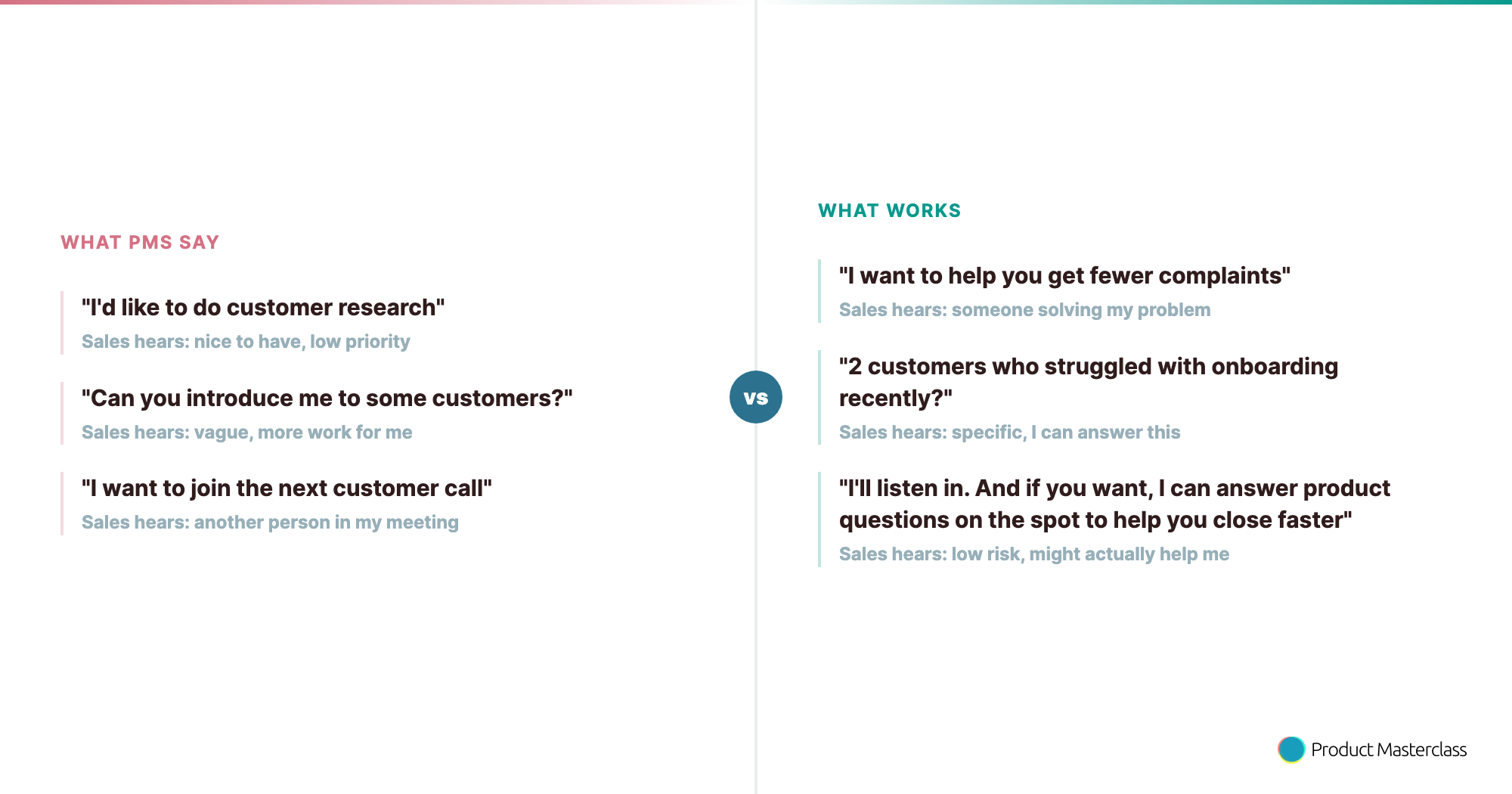
Here's what I've found works: I book time with account management, and I frame it very directly. I say, "Look. You are on the front lines with the customers every day, and you get all the complaints. I want to understand that a little better so that I can help you get less of them."
That's it. No research jargon. No "discovery interviews." Just: you deal with the problems, I want to fix them, let me hear what you're hearing.
This works because you're not asking for a favor. You're offering help. And you're speaking in terms they care about: fewer escalations, happier customers, less firefighting.
The key is specificity. Don't say "I'd like to talk to some customers." Say "I noticed the onboarding process has been causing questions. I want to understand what's tripping people up so we can fix it. Can you connect me with two or three customers who went through onboarding recently?"
Strategy 2: Join existing customer touchpoints
If your company does onboarding calls, sales demos, or regular check ins with customers, you already have a direct line to customer insights. You just need to be in the room.
The ask is simple: "Can I sit in on the next few onboarding calls? I can answer product questions on the spot so you don't have to follow up later."
Notice the difference: you're not asking to quietly observe. You're offering to be useful in the meeting. That makes you an asset, not a guest.
Two things happen when you do this:
First, you hear real problems in real time. Not filtered through anyone's interpretation. Not from a survey. From the customer's own words, in context.
Second, the customer gets to know you. And once they know you, you can approach them directly for follow up conversations. That's the real goal: building your own direct line to customers over time.
This is especially powerful in B2B environments where the same account manager may take weeks to respond to an email, but onboarding calls happen every week.
Strategy 3: Use the right email
When you do send that email to sales or account management, make it concrete and short. Here's the structure I use:
For sales teams:
Hi [name],
I'm looking into [specific issue you've noticed]. We're seeing [signal: support tickets, churn, complaints] around this, and I want to make sure we understand what's really going on before we build anything.
Could you connect me with 2 customers who experienced this recently? I'll keep it to a 20 minute call, and I'll share what I learn with your team afterward so you have better talking points for similar situations.
If it's easier, I can also just sit in on the next onboarding call. Happy to answer product questions on the spot so you don't have to follow up later.
For account managers:
Hi [name],
I know you hear a lot from customers about [area]. I'm working on improving that part of the product and want to make sure we build the right thing.
Could you think of 2 or 3 customers who brought this up recently? I'd love a short call with them. You decide who we talk to, and you're welcome to join any call. I'll share the summary with you afterward, so you know what we're prioritizing and why.
This should help in your conversations with them too.
Two things make these work: they're specific (not "I want to do research"), and they offer something back (you'll share what you learned).
Account managers: great source, wrong substitute
Let me be clear: account managers are a valuable source of insight. They hear things you'll never hear. They know which customers are happy, which are frustrated, and which are about to churn. Talk to them. Learn from them. They're often your fastest path to understanding which customers to approach and what to ask about.
The trap is when you interview them instead of the customer, thinking it's the same thing.
It's not. When you ask an account manager about customer problems, they tend to answer from their own perspective. "We need more self service." "We do too much manual work." "Customers keep asking for a dashboard." These sound like customer insights, but they're filtered through the AM's daily reality.
The AM wants less manual work. That's understandable. But does the customer actually want self service? Maybe they value the personal contact. Maybe they have so many questions that self service wouldn't help. You don't know until you ask the customer directly.
The distinction matters: use account managers to identify which conversations to have, and then have those conversations with the actual customers. Account managers point you to the right doors. Customers show you what's behind them.

Build your own insight pipeline
Here's the thing about customer access: the first conversation is the hard part. Once you've had that first call, you have a name, a face, a phone number. The next time you have a question about how they use your product, you don't need to go through sales or account management anymore. You just call them. Discovery goes from a multi-week negotiation to a phone call away.
So the real game is building up a network of customers you can reach directly. Every onboarding call you join, every interview you do, every follow up you send adds one more person to that network. After a few months, you don't have an access problem anymore.
To make that sustainable, systematize it:
Record everything (with permission). If your sales or CS team records onboarding or support calls, ask for access to those recordings. You can extract patterns across dozens of conversations quickly. You don't even need to join the calls yourself.
Be specific in your asks. "Can you think of 2 customers who struggled with [specific workflow] in the last month?" works. "Can you introduce me to some customers?" doesn't. Give account managers a specific enough question that they can actually answer it.
Share back what you learn. After every round of customer conversations, send a one page summary to the sales and AM team. Show them what you learned and what you're doing about it. This builds trust, and next time you ask for introductions, they'll say yes faster.
You need fewer interviews than you think. In my experience, after 5 to 8 interviews within the same customer segment, the same patterns start repeating. You don't need 50 conversations to act. You need the right 5, and then the courage to make a decision.
A note for product leaders
If multiple PMs on your team are struggling with customer access, this isn't a skills problem. It's a structural one. The most effective fix I've seen is sitting down with your sales counterpart and agreeing on a simple protocol: how product gets access, which accounts need a joint call, and what product shares back afterward. Solve it once at the leadership level, and your PMs can focus on the conversations instead of negotiating their way into them.
For key accounts, joint calls work well. Sales leads the relationship, product asks a few targeted questions. Both sides get what they need, and the customer sees a team that's aligned.
It's not about access. It's about positioning.
If you're struggling to get customer access, the fix isn't to push harder. It's to reposition your ask. Make it about their problems, not your research. Join their existing customer touchpoints. And always share what you learn.
The product managers who have the best customer relationships aren't the ones who asked for permission. They're the ones who made themselves useful.
At Product Masterclass, we train product managers to work effectively in the AI era. Our 8-week intensive program covers everything from customer interviews to vibe coding to building your personal AI workflow. Check out the next cohorts
Discover where product management is heading
Stay up to date with our Product Newsletter and do not miss out on free articles, videos, templates, events on Product Management